That Wasn't Your Son Calling: How AI Voice Cloning Scams Work and How to Stop Them


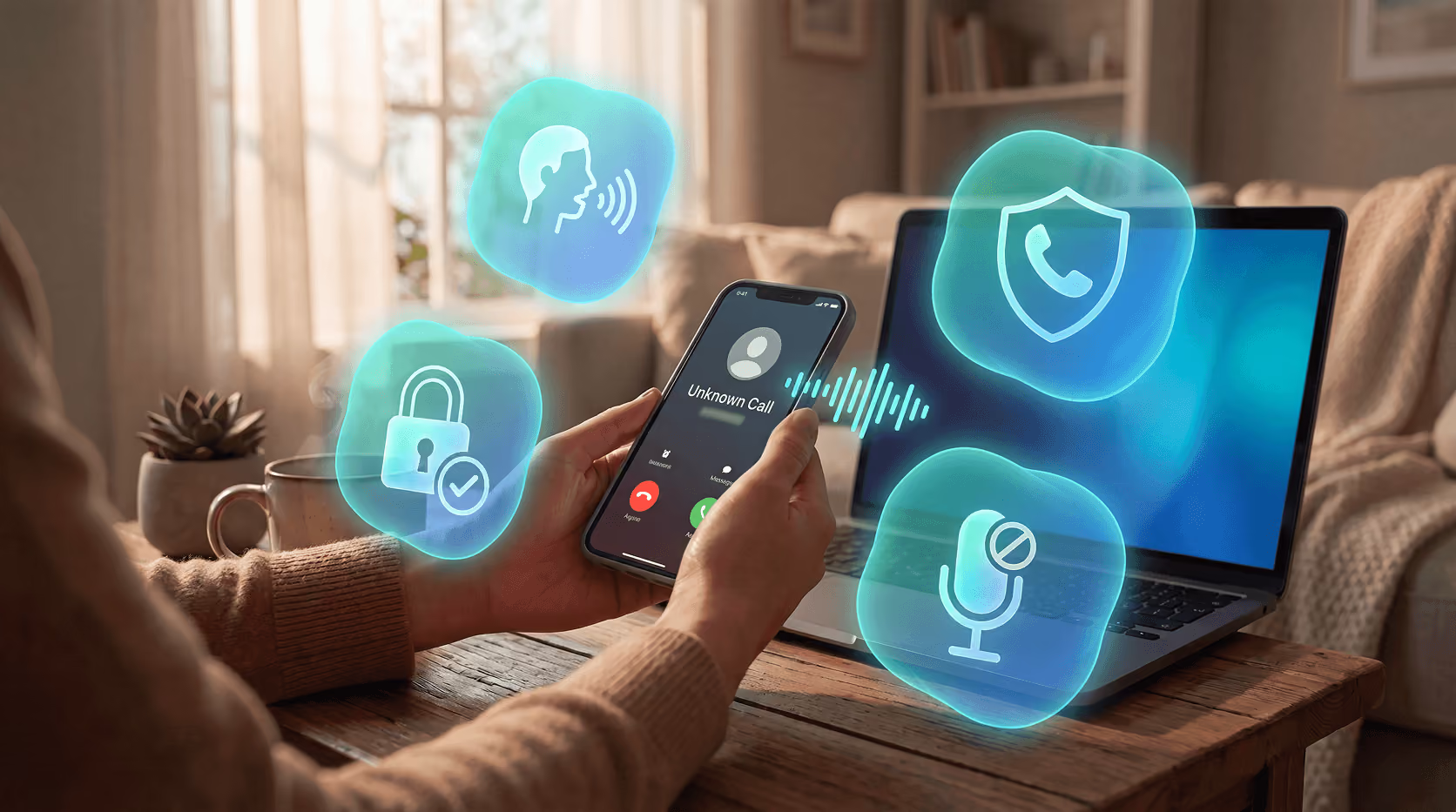
Key Takeaways
Your phone rings. The voice on the other end sounds exactly like your son, panicked, crying, saying he's been arrested and needs bail money right now. Your stomach drops. You don't think. You act.
That's the point. AI voice cloning scams are built around a single biological fact: when you hear the voice of someone you love in distress, your brain stops asking questions.
The technology behind these calls is no longer science fiction. It's widely available, cheap to use, and terrifyingly good. And it's coming for everyday people, not just politicians or executives.
Here's what's actually happening, and what you can do about it.
What is an AI voice cloning scam?
An AI voice cloning scam is a type of fraud where criminals use artificial intelligence to replicate someone's voice, then use that fake voice to manipulate the target into sending money.
The setup follows a familiar script. A scammer calls you pretending to be a loved one, usually a child, grandchild, or close friend. The cloned voice sounds distressed. There's an emergency: a car accident, an arrest, a kidnapping. Money is needed immediately. And for the love of everything, don't tell anyone else.
What's new isn't the emotional manipulation. Grandparent scams and virtual kidnapping have existed for years. What's new is that the voice now sounds real, because in a technical sense, it is.
How scammers clone a voice in seconds
Modern voice cloning tools don't need much to work with. McAfee research found that roughly three seconds of clear audio is enough to produce an 85% voice match, with accuracy improving the more audio a scammer has. National Cybersecurity Alliance puts the threshold for a fully convincing clone closer to 30 seconds. Either way, the bar is low: a voicemail greeting, a TikTok video, or a brief answer to a wrong-number call can be enough to get started.
Scammers typically pull source material from social media, where people post videos freely and without thinking about the audio they're putting out into the world. From there, AI tools reproduce the voice, its cadence, its tone, its small imperfections, and generate new speech from a script the scammer writes.
More advanced versions go further. A technique called "voice skinning" lets a scammer speak in real time and have their voice transformed to sound like someone else. That means a live, two-way conversation with what sounds like your daughter. No pre-recorded clip. No awkward pause. Just a convincing, responsive voice that answers your questions.
On top of that, caller ID spoofing means the call can appear to come from a number you already recognize.
The scale of the problem
These aren't isolated incidents. The FBI's Internet Crime Complaint Center's 2025 report, released in April 2026, recorded $893 million in losses from AI-related scams, across more than 22,000 complaints, and that figure almost certainly understates the real damage. Congressional researchers estimate fewer than 5% of voice-clone victims ever file a report.
McAfee found that 77% of people targeted by a convincing AI voice-clone call end up losing money. As far back as 2023, one in four adults had either experienced an AI voice scam directly or knew someone who had.
The trend line only goes one way. Deloitte's Center for Financial Services projects that generative AI could push US fraud losses from $12.3 billion in 2023 to $40 billion by 2027.
Real cases illustrate what the numbers mean in practice, though it's worth noting upfront that in every documented case, including the ones below, law enforcement and forensic experts have not been able to independently confirm after the fact whether the voice was a true AI clone or a skilled human impersonator on a distorted line. That verification gap is itself one of the more unsettling parts of the story.
A mother in Martinez, California says she lost $5,400 after scammers played what she was certain was her 37-year-old daughter's voice, claiming a cartel kidnapping and directing her to wire money from multiple locations over five hours.
A woman in Hillsborough County, Florida says she was conned out of $15,000 after hearing what she describes as her daughter's voice, crying and pleading for bail money; county detectives opened an investigation but have not publicly confirmed AI was involved.
And in the most thoroughly documented account on record, Scottsdale, Arizona mother Jennifer DeStefano testified before the US Senate Judiciary Committee in June 2023 that she heard what sounded exactly like her daughter sobbing that she'd been kidnapped, with a ransom demand that escalated to $50,000 — she nearly paid before confirming her daughter was safe at home the entire time. In each case, the voice was convincing enough to override skepticism, even though none of them can be forensically proven to be AI rather than human.
Why your ears can't save you
The uncomfortable truth: you probably can't tell the difference.
Signs people used to rely on, strange pauses, robotic cadence, flat emotional tone, are largely gone from current AI voice systems. Henry Ajder, an expert on AI-generated media who consults for governments and companies, told CNN: "For the everyday person, it is just not fair to expect them to be able to spot this stuff. I struggle with it. Most people do."
That's not a reason to panic. It's a reason to change your approach entirely. Instead of trying to detect whether a voice is real, focus on the behavior patterns that real emergencies don't produce.
Scams tend to share a few tells:
- Urgency is manufactured. Real emergencies don't require you to act before you can verify anything. "You have to send money in the next 30 minutes" is a pressure tactic, not a logistical reality.
- Secrecy is suspicious. "Don't tell your wife" or "don't call anyone else" is how scammers prevent you from doing the one thing that would expose the call: contacting the real person.
- The payment method is a red flag. Wire transfers, gift cards, cryptocurrency, or cash handed to a stranger are not how legitimate emergencies get resolved.
Notice these signals before you engage with whether the voice sounds real.
How to protect yourself (and your family)
The most effective defense isn't a detection tool. It's a habit.
Set up a family code word. Choose a word or short phrase that only your immediate family knows, something not findable in any social media post or email. If you get a call claiming to be a family member in crisis, ask them to say it. A real person will know it instantly. A scammer won't.
Always verify through a second channel. Don't call back on the number that just called you. Hang up and dial the person directly from your own contacts. If your son allegedly just called you from jail, text your son. Call your daughter-in-law. Reach out to someone who would know where they are. This takes two minutes and it works every time.
Limit your family's public audio footprint. You don't need to purge the internet of every video, but it's worth thinking about. Private social media accounts, turning off open commenting, and avoiding public live video reduce how much raw voice data is available to anyone who wants to build a clone.
Talk to your family about this now, before a call comes. The time to establish a code word and a verification plan is not when you're standing in your kitchen shaking because you just heard your granddaughter crying. Have the conversation now, while no one is scared.
Be especially skeptical of urgency and secrecy. Scammers win when you're too panicked to think. A real family member in a real emergency won't be offended if you hang up to call them back. An AI voice in a scam call can't actually be offended at all.
Conclusion
The voice you hear might be perfect. The timing might feel impossible to question. But the structure of the call, the pressure, the secrecy, the unusual payment request, will still be there if you know what to look for.
AI voice cloning is one of the most psychologically effective scams ever built. It works because it targets love and fear at the same time, giving your brain almost no room to reason its way out. The answer isn't to become suspicious of everyone you care about. It's to build a simple, shared system before you ever need it.
A code word takes two minutes to agree on. It could save thousands of dollars and a lot of heartbreak.
Guardio's Critical Security Alerts feature adds another layer of defense: its AI watches for high-risk scam patterns, and if you're at risk, Guardio's security experts call and text you directly to help you avoid an in-progress scam. It works alongside the browsing and phone protection Guardio already provides.
Get started with a free scan and stay one step ahead of scams that are built to catch you off guard.
FAQs
How do AI voice cloning scams work?
Scammers use AI tools to replicate a person's voice from a short audio sample, often pulled from social media, and then use that cloned voice to impersonate a family member in a fake emergency. The goal is to get you to send money quickly, before you have a chance to verify anything.
How much audio does a scammer need to clone a voice?
McAfee research found that roughly three seconds of clear speech is enough to produce an 85% voice match, and the National Cybersecurity Alliance puts the threshold for a fully convincing clone closer to 30 seconds. Either way, the source can be as simple as a voicemail, a social media video, or a brief answer on a wrong-number call.
Can I tell if a voice on the phone is AI-generated?
In most cases, no. AI voice quality has improved to the point where most people, including security experts, can't reliably detect a clone by ear. Focus on the behavior of the call, urgency, secrecy, unusual payment demands, rather than trying to judge the voice itself.
What is a family code word and how does it help?
A family code word is a pre-agreed word or phrase that only close family members know. If someone calls claiming to be a family member in distress, asking for the code word quickly exposes a scammer who won't know it. It's one of the most effective and simplest defenses available.
What should I do if I think I'm receiving an AI voice cloning scam call?
Hang up. Then contact the person the caller was impersonating directly, using a phone number you already have saved. Don't call back the number that called you. If you've already sent money, report it to the FTC at reportfraud.ftc.gov and your bank immediately.
Are AI voice cloning scams illegal?
Yes. In the US, the FCC ruled in February 2024 that AI-generated voices in robocalls are illegal under the Telephone Consumer Protection Act. The FTC also treats voice cloning used for fraud as impersonation and deception, subject to enforcement action.
Who is most at risk from AI voice cloning scams?
Anyone can be targeted, but older adults are disproportionately affected, particularly grandparents, who scammers often target with fake calls from a grandchild in trouble. People who share a lot of voice content publicly on social media also face higher risk because scammers have more raw audio to work with.
%201.avif)