The Complete Guide to Travel and Delivery Scams (2026)


Key Takeaways
Introduction
You've probably heard the warning before: "If it sounds too good to be true, it probably is." But in 2026, scammers aren't relying on obvious promises anymore. They're using AI to clone real airline websites, voice-synthesize legitimate travel agents, and send delivery texts so convincing that even careful people get fooled.
The numbers back this up. The FTC reported that consumers lost $274 million to travel scams in 2025 alone — and overall fraud losses hit $12.5 billion, a 25% jump over the previous year. The FBI's Internet Crime Complaint Center logged another $16.6 billion in cybercrime losses, a 33% increase from 2024. Non-delivery fraud — where you pay and never receive your goods — cost Americans more than $503 million.
These aren't abstract statistics. They represent real people who booked a vacation rental that didn't exist, clicked a USPS text link that drained their bank account, or paid a fake travel agent who vanished before the trip.
This guide covers it all: every major travel and delivery scam type, the AI tools making them harder to detect, the red flags to watch for, and critically exactly what to do in the first 24–72 hours if you've been targeted. Consider this your year-round playbook for staying one step ahead.
How AI Changed Everything About Scams
Before we dive into the individual scam types, it's worth understanding why 2025–2026 feels different. The tools available to everyday scammers have undergone a step change.
- Fake websites spun up in minutes. AI now enables fraudsters to clone fully functional travel booking websites complete with stolen photos, fabricated reviews, and live-looking pricing in a fraction of the time it used to take.
Guardio Labs' research into AI-assisted scamming found that popular AI agents can be prompted to generate functional phishing infrastructure with minimal friction what once required real technical skill now takes a conversation and a few minutes.
- Voice cloning for real-time deception. Scammers are now using AI voice synthesis to impersonate travel agents over the phone. You call a number you found via a Google ad (more on that below), and you're speaking to what sounds like a real, warm, professional agent who is, in fact, an AI-generated criminal construct.
- Delayed billing to avoid fraud detection. One increasingly common tactic: fraudsters take your credit card details but delay the actual charge by weeks. By the time you see the charge, you may not remember the transaction and the dispute window may be tighter.
- Near-perfect phishing. AI-generated emails and texts are now largely free of the spelling errors and awkward phrasing that used to give phishing attempts away. A fake FedEx delivery notification generated in 2026 looks indistinguishable from the real thing.
Understanding this context matters because it reframes the old advice. "Just look for typos" no longer cuts it. The red flags have shifted and we'll show you what to look for now.
Travel Scams: The Full Breakdown
Here are the six travel scam types you're most likely to encounter and exactly how each one works.
1. Fake Booking Websites
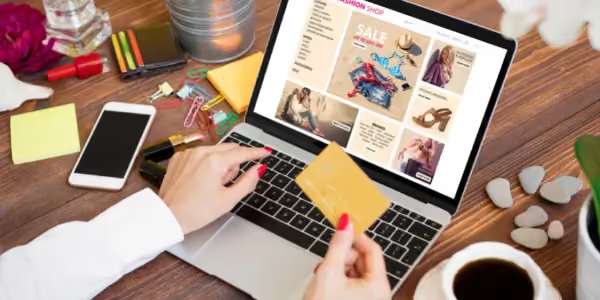
Fraudulent websites impersonating airlines, hotels, and online travel agencies (OTAs) like Booking.com or Expedia are among the most common and costly travel and delivery scams. In fact, research into Booking.com hotel scams has revealed just how sophisticated and widespread these impersonation schemes have become.
These sites often surface at the top of Google results not because they're legitimate, but because scammers buy paid search ads to place them there.
- How it works: You search for a flight or hotel, click a sponsored result, and land on a site that looks completely real. You enter your payment details and receive a confirmation email. Weeks later sometimes days before your trip you discover the reservation doesn't exist.
- Red flags:
- You found the site via a Google ad, not the brand's official domain
- The URL has slight variations (e.g., "booking-deals-hotels.com" instead of "booking.com")
- You're asked to pay via wire transfer or cryptocurrency
- Prices are significantly below market rate
- What to do instead: Navigate directly to airline and hotel websites by typing the URL yourself. When using an OTA, verify it's on the official app or a bookmark you saved previously.
2. Vacation Rental Scams
The FTC has logged approximately 65,000 vacation rental scam reports over the past five years, totaling around $65 million in losses. Families have lost $7,000 or more on a single fraudulent listing.
- How it works: A listing appears on a rental platform or is posted independently on Craigslist, Facebook Marketplace, or a cloned VRBO-style site. The photos are real (scraped from legitimate listings). The scammer communicates convincingly, requests a deposit or full payment off-platform, and then disappears.
- Red flags:
- The "host" asks you to pay via Venmo, Zelle, wire transfer, or gift cards
- Communication moves off the rental platform quickly
- The listing has very few reviews, or reviews that feel generic
- The price is considerably below comparable properties in the area
- What to do instead: Only book through platforms with verified payment protection. Never send money outside the platform's official system. Reverse-image-search the listing photos to check if they appear elsewhere.
3. Robocalls and Unsolicited Free Trip Offers
You get a call. You've won a free vacation! A cruise for two! A resort stay in Cancún just pay the taxes and fees.
This is a classic pitch with a modern twist: robocall technology now allows scammers to reach thousands of people per hour, and AI-generated voices make the calls feel personal.
- Red flags:
- You didn't enter any contest
- They ask for credit card details to cover "small fees"
- There's urgency: "This offer expires in 24 hours"
- Pressure to decide immediately without written documentation
4. Fake Customer Service Numbers
Search "United Airlines customer service" or "Airbnb support number" and the first result may be a Google ad for a fake number. You call it, a convincing agent answers, and they take your payment details to "fix" your booking.
This is one of the most underreported scams because the victim blames themselves for clicking a Google ad. Google does attempt to filter these, but scammers rotate domains and ads faster than moderation can keep up.
- Red flags:
- The phone number appeared in a paid ad, not on the company's official site
- The agent asks for payment via wire transfer or gift card to "process a refund"
- You called about a refund and they ask you to pay first
5. Travel Document Scams (Visas and IDPs)
Planning an international trip? Fraudulent services impersonating official government visa processors or International Driving Permit (IDP) issuers are widespread. Real IDPs cost under $20 from AAA or AATA. Fake services charge $50–$100+ for a document that won't hold up at a foreign border.
- Red flags:
- The site uses urgent language like "official," "government-authorized," or "required by law"
- Prices are higher than the known official source
- The site doesn't clearly identify who operates it
6. Loyalty Program and Points Theft
Your frequent flier miles or hotel reward points have real monetary value and scammers know it. Phishing emails impersonating airline loyalty programs are designed specifically to capture your credentials, drain your points, and transfer them to gift cards or third-party accounts.
- Red flags:
- An email asks you to "verify your account" or "claim expiring points"
- The link goes to a domain that isn't the airline's official site
- You receive a "points expiration" warning out of the blue
Delivery Scams: The Full Breakdown
Here are the four delivery scam types hitting consumers hardest right now and how to recognize each one.
1. Smishing (Fake Delivery Texts)
The United States Postal Inspection Service (USPIS) flagged delivery smishing as one of the top fraud vectors in 2025. You receive an SMS claiming your USPS, FedEx, or UPS package has a problem delivery attempted, address incomplete, customs fee required. There's a link. You click it. You enter your details to "reschedule delivery." That's the trap.
Here's the critical thing to know: USPS does not send text messages with links unless you've specifically signed up for tracking notifications. If you get an unsolicited delivery text with a link, it's a scam.
- Red flags:
- You didn't sign up for text tracking
- The link goes to a non-.gov or non-official domain
- You're asked to enter payment details to release a package
- The message has a generic greeting ("Dear Customer") rather than your name or tracking number
2. Non-Delivery Fraud
You find a great deal online on a marketplace, a social media shop, or an unfamiliar website. You pay. Nothing arrives. The seller is unreachable. This category cost Americans more than $503 million in 2025 according to the FBI's Internet Crime Complaint Center.
Non-delivery fraud spikes during high-volume shopping periods (holidays, Prime Day, back-to-school), but it happens year-round.
- Red flags:
- The seller only accepts payment via Zelle, Venmo, cryptocurrency, or wire transfer
- The site was discovered via a social media ad, has no reviews, and was recently created
- No clear return/refund policy or physical business address
3. Brushing Scams
Here's one most people don't recognize as a scam at all: you receive a package you didn't order. No return address. Items you've never heard of. It feels like a gift but it's a sign your personal data has been compromised.
In a brushing scam, fraudulent marketplace sellers use your real name and address (obtained from data breaches or the dark web) to send cheap packages, then post fake reviews on your account to inflate their product ratings. The USPIS issued a warning about this practice in 2025.
- What to do:
- Don't use the items — or do, but understand the implications
- Report it to the marketplace and USPIS
- Change your passwords on shopping accounts
- Check for identity theft via your credit report and an identity monitoring service
4. QR Code Delivery and Travel Scams (Quishing)
This one bridges both worlds. Fraudsters place fake QR code stickers over legitimate ones in high-traffic areas parking meters at tourist destinations, hotel concierge desks, even paper delivery notices left on your door.
You scan what looks like a parking payment QR code, a hotel Wi-Fi QR code, or a delivery rescheduling notice, and you're sent to a phishing page designed to capture payment details or login credentials.
- Red flags:
- The QR code is a sticker placed over another code (look for raised edges or misalignment)
- A paper notice was left on your door asking you to scan to "reschedule delivery"
- The QR code destination URL looks unfamiliar or doesn't match the expected service
Your Red Flag Master Checklist
Across all scam types, these are the consistent warning signs:
- 🚩 Pressure to decide immediately legitimate businesses give you time
- 🚩 Non-standard payment requests wire transfer, gift cards, Zelle, or cryptocurrency are not reversible
- 🚩 Too-good-to-be-true pricing especially on travel deals or rare products
- 🚩 Contact initiated from unsolicited text, email, or call you didn't ask for it
- 🚩 Links in texts from delivery carriers you didn't sign up to receive
- 🚩 Customer service numbers found via Google ads instead of official domains
- 🚩 Communication moved off-platform from Airbnb to WhatsApp, for example
- 🚩 Unsolicited packages you didn't order potential brushing scam
- 🚩 Requests for personal info to "verify" or "release" something
What to Do in the First 72 Hours After a Scam
Speed matters enormously. Here's exactly what to do in order:
- Within 2 hours:
- Contact your bank or credit card company. Report the fraudulent charge immediately. Credit cards offer the strongest protection recovery rates approach 100% when reported quickly. Debit cards and wire transfers have far weaker protections.
- Change your passwords for any accounts you used during the transaction. Use a unique password for each.
- Document everything. Screenshot the website, texts, emails, or social posts. Note the exact date and time.
- Within 24 hours:
- Report to the FTC at ReportFraud.ftc.gov. This creates an official record and can trigger investigations.
- Report to the FBI's IC3 at ic3.gov for any online fraud over $100.
- If it was a delivery smishing text: Forward it to spam@uspis.gov and report to your carrier by texting 7726 (SPAM).
- Within 72 hours:
- Freeze your credit with Equifax, Experian, and TransUnion if you shared financial or identity information. This is free and prevents new accounts being opened in your name.
- Monitor your accounts for unusual activity. If you received an unsolicited package (brushing), check your credit report for new accounts or inquiries.
- Alert the platform Airbnb, VRBO, the marketplace, or the travel OTA so they can investigate and protect others.
How Guardio Helps
Scammers are moving faster than ever, and the best defense is one that works before you click, not after.
Guardio is cross-device protection for your digital life, working on your browser and mobile to keep you safe at all times. Its next-gen security proactively detects and blocks malicious sites, phishing pages, and fake booking sites in real time — identifying threats like smishing links before you ever enter any details.
Our identity breach monitoring alerts you when your data appears in places it shouldn't, which is often how brushing scams start.
You shouldn't have to be a cybersecurity expert to stay safe online. We're here to make sure you don't have to be.
Conclusion
Travel and delivery scams are getting harder to spot not because people are less careful, but because the tools scammers use have become genuinely sophisticated. AI-generated websites, voice-cloned agents, and near-perfect phishing texts have raised the bar for everyone.
The good news: the core defenses haven't changed. Verify through official channels. Never pay via irreversible methods. Move fast if something feels wrong. And keep a tool like Guardio running in the background, so the first line of defense isn't you clicking a link it's a system that never sleeps.
FAQs
How do I know if a travel website is legitimate?
Navigate directly to the airline, hotel, or OTA's official website by typing the URL yourself never click a link from an email or a paid search ad. Verify the URL exactly (look for subtle typos or extra words). If in doubt, call the company using a number from their official site.
Does USPS ever send links in text messages?
Only if you've specifically enrolled in USPS text tracking for a shipment. Any unsolicited delivery text with a link asking you to pay a fee or confirm personal details is a scam. Forward it to spam@uspis.gov.
What should I do if I receive a package I didn't order?
It's likely a brushing scam. Report it to the marketplace and USPIS, change your account passwords, and check your credit report for unusual activity. Your data may have been exposed in a breach.
Is it safe to scan QR codes at tourist locations?
Check that the QR code isn't a sticker placed over another code (look for misalignment or raised edges). Preview the URL destination before proceeding. When in doubt, find the official website manually.
What's the fastest way to get money back after a travel scam?
Contact your credit card company within two hours of discovering the fraud. Credit card chargebacks have the highest recovery rate. Wire transfers, Zelle, and gift card payments are extremely difficult to reverse which is exactly why scammers prefer them.
How are AI-powered scams different from traditional ones?
AI allows scammers to create convincing fake websites, generate flawless phishing content, and even clone voices in real time at massive scale. The old advice to 'look for typos' is no longer reliable. Focus on verifying sources through official channels, not on how polished the communication looks.
Can I recover from a brushing scam if I used the items sent?
Using the items doesn't put you at financial risk. The real concern is that your data is in the wrong hands. Change passwords, check your credit report, and consider an identity monitoring service to catch further misuse.
What payment methods protect me best against online scams?
Credit cards offer the strongest consumer protection: dispute rights, fraud liability limits, and chargeback options. Debit cards, wire transfers, Zelle, Venmo, cryptocurrency, and gift cards offer little to no protection once the payment is made.