

Session Hijacking: How Stolen Browser Cookies Let Hackers Skip Your Password Entirely


Key Takeaways
You changed your password. You turned on two-factor authentication. You did everything right, and a hacker still walked straight into your account. No password prompt. No verification code. Nothing.
This is session hijacking, and it's one of the most quietly effective cyberattacks happening right now. It doesn't crack your password. It doesn't need to. It steals the digital key your browser already holds, and uses it to walk in as you.
What is a session cookie, anyway?
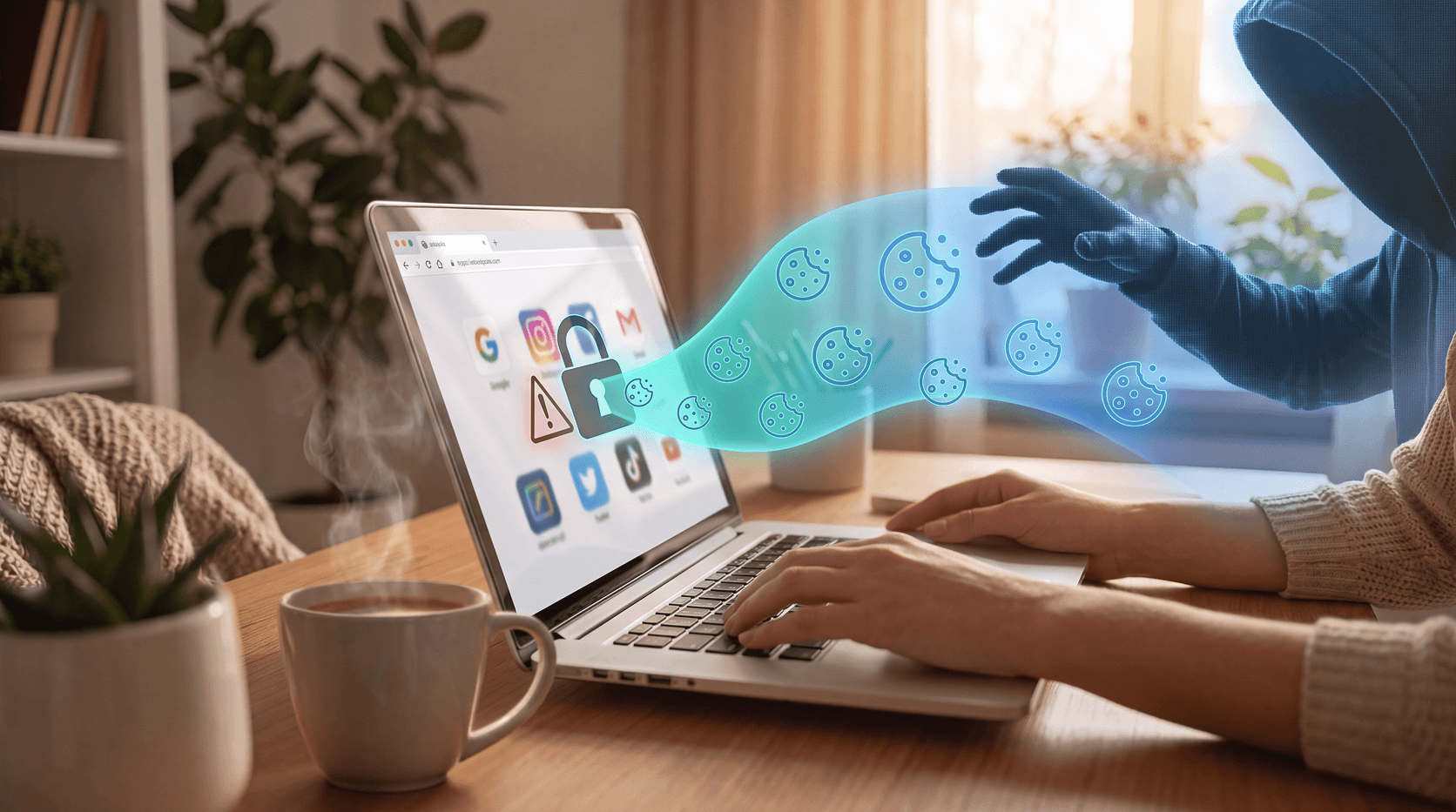
Every time you log into a website (your bank, your email, a shopping site) the site hands your browser a small piece of data called a session cookie. Think of it like a wristband at a concert. You showed your ticket at the door (your username and password), and now you're wearing the wristband. Nobody checks your ticket again. They just look at the wristband.
That wristband is your session cookie. It's a unique string of characters stored in your browser that tells the website: "This person already logged in, let them through."
Session cookies are what let you browse Instagram for hours without being asked to log in every few minutes. They're convenient by design. And that convenience is exactly what attackers exploit.
What is session hijacking?
Session hijacking (also called cookie hijacking) is when an attacker steals your active session cookie and uses it to impersonate you on a website, without ever needing your password.
Once they have your cookie, they load it into their own browser. The website sees the wristband and waves them in. From the site's perspective, there's no difference between you and the attacker. You're both wearing the same wristband.
The result? The attacker has full, authenticated access to your account (your emails, your files, your payment methods, your messages) while you're none the wiser.
Why this attack makes your password (and even MFA) irrelevant
Most people assume that a strong password (or better yet, two-factor authentication (MFA)) protects them from account takeover. For most attacks, that's true.
Session hijacking is the exception.
Here's why: MFA only runs at login. Once you've passed the login screen and your browser holds a valid session cookie, the authentication step is already done. The site trusts your cookie, not your password. If an attacker steals that cookie after you've authenticated, your MFA never gets a chance to stop them.
This is sometimes called an AiTM (Adversary-in-the-Middle) attack when done in real time. But attackers don't even need to be in the middle of your connection anymore. Modern infostealer malware silently harvests session cookies directly from your browser and sends them to an attacker's server, sometimes minutes after you've logged in.
Bottom line: A stolen session cookie is a stolen authenticated session. Password strength doesn't matter. MFA doesn't matter. The damage is already done.
How do hackers steal your session cookies?
There are several methods, ranging from sophisticated network attacks to click-and-done malware installs:
Infostealer malware
This is the most common method today. Infostealer malware (programs like RedLine, Raccoon, and Lumma) are built specifically to scrape session cookies from browsers like Chrome, Firefox, and Edge. They run silently in the background after being installed through a phishing email, a fake software download, or a malicious browser extension.
Once active, they export your browser's cookie database and ship it off to an attacker-controlled server. The whole process can take seconds.
Cross-site scripting (XSS)
In an XSS attack, a hacker injects malicious JavaScript code into a legitimate website. When you visit that page, the script runs in your browser and reads your session cookie, sending it back to the attacker. This works especially well on sites with poor input sanitization.
Man-in-the-middle (MitM) attacks
On an unsecured or compromised Wi-Fi network, an attacker can intercept the traffic between your browser and a website. If that traffic isn't properly encrypted, your session cookie travels in the open, and they catch it.
Packet sniffing
Similar to MitM, packet sniffing involves capturing raw network traffic. On shared networks (public Wi-Fi at a café, hotel, or airport), an attacker running a packet sniffer can harvest cookies from anyone else on the same network connecting to HTTP (non-HTTPS) sites.
Malicious browser extensions
Rogue browser extensions (ones disguised as productivity tools, ad blockers, or PDF converters) can have permission to read browser data, including cookies. Once installed, they quietly copy session tokens and send them to the attacker.
A real-world scenario: how a session hijack actually plays out
Imagine you're working from a coffee shop. You log into your company's project management tool and your personal Gmail. You've got MFA on both, you feel secure.
Meanwhile, a malicious extension you installed three weeks ago (it said it was a "free PDF compressor") is running in your browser. Silently, it reads the session cookies your browser holds for both accounts and sends them to a remote server.
Hours later, while you're asleep, an attacker loads your Gmail cookie into their browser in a different country. Google sees a valid session. No login needed. They search your emails for password reset links, bank statements, and any other accounts they can pivot to.
By morning, they've changed your recovery email, locked you out, and started the same process on your other accounts.
You never saw a suspicious login prompt. No red flags. Because from Google's perspective, you were the one logged in the whole time.
How to tell if your session has been hijacked
Unlike most cyberattacks, session hijacking often leaves almost no obvious trace, especially in the early stages. But there are warning signs to watch for:
- Unexpected logouts. Being signed out of an account you didn't manually log out of could mean a duplicate session was terminated.
- Unfamiliar activity in your account. Emails marked as read that you haven't opened, files you didn't access, settings you didn't change.
- Login notifications from new locations. If a service sends you alerts about new sign-ins, watch for geographic anomalies.
- Sessions you don't recognize. Many platforms (Google, Facebook, Microsoft) let you see active sessions. Any unfamiliar device or location is a red flag.
How to protect yourself from session hijacking
You can't see a cookie being stolen. But you can make sure attackers can't use one if they get it.
Keep your browser and OS updated. Patches close the security holes that malware exploits to access browser storage. An out-of-date browser is an open door.
Use HTTPS-only browsing. Never enter sensitive information, or stay logged in, on HTTP (non-padlock) websites. Stick to HTTPS, which encrypts your session data in transit.
Avoid public Wi-Fi for sensitive accounts. Or use a trusted VPN if you must. Public networks are prime hunting grounds for MitM and packet-sniffing attacks.
Be ruthless about browser extensions. Only install extensions from trusted publishers with a verifiable track record. Regularly audit what's installed and remove anything you don't actively use or recognize.
Log out of accounts when you're done. Ending a session terminates the session cookie. An expired cookie is worthless to an attacker.
Check active sessions regularly. For Google, Microsoft, Facebook, and other major platforms, visit account security settings and review active sessions. Kill any you don't recognize.
Use a real-time security tool across your devices. A security layer inside your browser, like Guardio, can detect and block the malicious extensions, phishing pages, and suspicious scripts that are the delivery mechanism for most cookie-theft attacks — and its companion mobile app extends breach alerts and phishing protection to your phone. Guardio monitors your browser environment in real time, flagging threats before they get a chance to exfiltrate your data.
How Guardio protects you from session hijacking
Session hijacking starts in your browser. So the best place to stop it is in your browser.
Guardio's browser extension actively monitors for the threats that enable session hijacking — and since account takeovers don't stop at your desktop, its mobile app keeps watching for compromised credentials on your phone too:
- Malicious extensions. Guardio scans installed extensions and flags any behaving suspiciously or associated with known malware campaigns.
- Phishing sites. Many infostealers are delivered via phishing links. Guardio blocks known phishing domains before they load.
- Suspicious scripts and pages. Guardio's real-time scanning inspects the sites and scripts you encounter as you browse, flagging behavior associated with known malware and phishing campaigns before they can act.
- Identity breach monitoring. Guardio scans the dark web for your email address and phone number, and alerts you the moment they turn up in a data leak, so you can change your passwords before that exposure is used against you.
Because session hijacking bypasses login entirely, detection and early interception are everything. Guardio gives you that layer of active defense where the attack actually happens.
Conclusion
The cybersecurity world spent years telling us that strong, unique passwords are the answer. And they are, for a lot of attacks. But session hijacking is proof that attackers are always looking for the next angle.
They don't need your password if they already have your session. They don't need to break down the door if you've already let them inside.
The fix isn't to abandon passwords or MFA, those still matter. The fix is to protect the post-login layer: your active browser session, your installed extensions, and the scripts running on the pages you visit every day.
That's where session hijacking lives. And that's exactly where Guardio is watching.
FAQs
What is session hijacking?
Session hijacking is a cyberattack where a hacker steals your active browser session cookie and uses it to access your online accounts without your password. Because the session is already authenticated, the attacker bypasses login screens and MFA entirely. It's one of the few attack types where a strong password offers no direct protection.
Can session hijacking bypass two-factor authentication?
Yes. Session hijacking bypasses two-factor authentication (MFA) because MFA only checks your identity at login. Once you're logged in and your browser holds a valid session cookie, that cookie alone grants access. If an attacker steals it after authentication, your MFA has already served its purpose and can't intervene.
How do hackers steal browser cookies?
Hackers steal browser cookies primarily through infostealer malware (such as RedLine, Raccoon, and Lumma), which scrapes cookie data directly from browsers like Chrome and Firefox. Other methods include malicious browser extensions, cross-site scripting (XSS) attacks, man-in-the-middle attacks on unsecured Wi-Fi, and packet sniffing on public networks.
How can I tell if my session has been hijacked?
Signs of session hijacking include unexpected logouts, unfamiliar account activity (emails marked read, changed settings), login alerts from unrecognized locations, and active sessions on devices you don't own. Most major platforms (Google, Microsoft, Facebook) let you review active sessions in your security settings, checking there regularly is one of the best early-detection steps.
Does logging out protect against session hijacking?
Yes. Logging out terminates the session cookie, which makes it worthless to any attacker who stole it. A cookie from an ended session can't be used to re-enter your account. Logging out of accounts you're not actively using is a simple and effective way to reduce your exposure to session hijacking.
What is the most common way session hijacking happens today?
Today, infostealer malware is the most common method of session hijacking. Programs like RedLine, Raccoon, and Lumma are installed through phishing emails, fake software downloads, or rogue browser extensions. Once active, they silently copy your browser's cookie database and send it to an attacker's server, often within seconds of infection.
How does Guardio protect against session hijacking?
Guardio protects against session hijacking by monitoring your browser in real time for the threats that enable it. Guardio scans installed extensions for malicious behavior, blocks phishing sites that deliver infostealer malware, detects suspicious scripts attempting to read browser data, and alerts you if your credentials appear in dark web data dumps or stealer logs.


%201.avif)


