Job Offer Text Scam 2026: Red Flags and the Safest Next Steps



Key Takeaways
- Legitimate employers do not recruit via random text: Real companies use job boards, LinkedIn, and company career pages.
- The scam is identity theft or money theft: They want your SSN, bank details, or upfront payments.
- "Pay to work" is never legitimate: Real jobs do not require you to pay for training, equipment, or background checks.
- Fake check scams target job seekers: If they send you a check to deposit, it will bounce and you will lose money.
- Urgency is the red flag: "Start tomorrow" pressure is designed to skip verification.
If a job offer arrives by text and pushes urgency, treat it as unverified. Confirm the company and recruiter through official channels before you share any personal information.
{{component-cta-custom}}
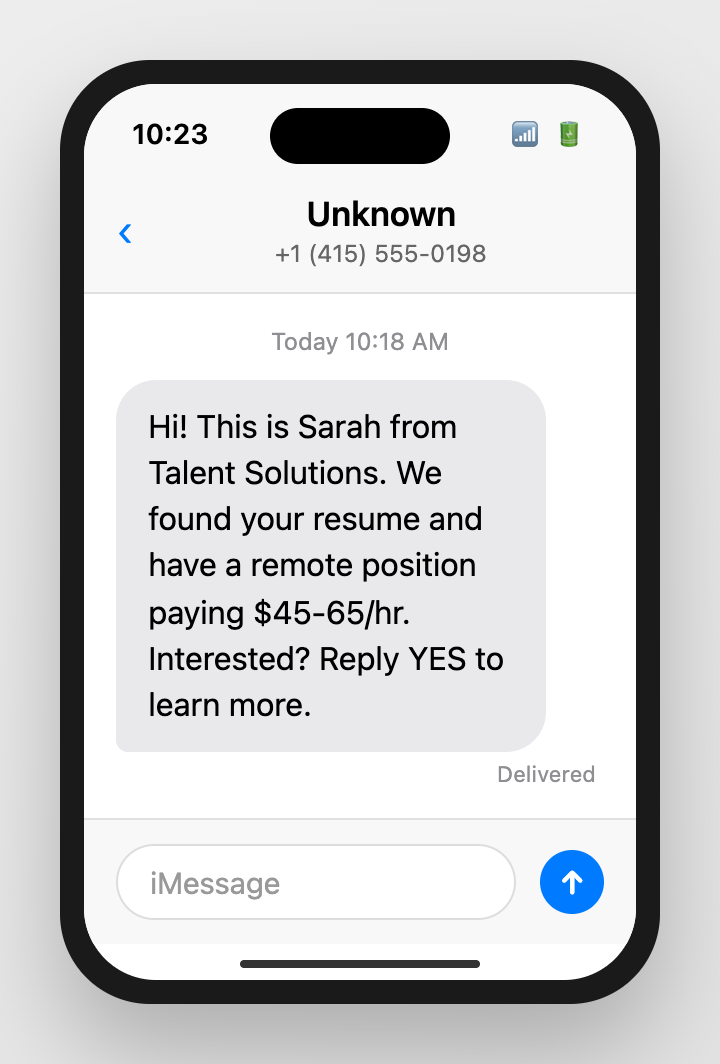
Why Job Scams Start With a Friendly Text
Job seekers are in a vulnerable position. They need income, they are often applying to many positions, and an unexpected opportunity feels like good news. Scammers exploit all of this.
The text message opener works because recruiting is noisy. People receive legitimate outreach from recruiters, so a text does not immediately feel suspicious. The scam becomes clear later, when they ask for personal information, payment, or to deposit a suspicious check.
The Psychology of Job Scams
- Hope and desperation: Job seekers want offers to be real. This creates confirmation bias.
- Authority positioning: "HR Department" or "Hiring Manager" triggers compliance.
- Urgency creation: "Position fills tomorrow" compresses your decision time.
- Reciprocity: Sending you a check first creates a sense of obligation.
- Legitimacy theater: Official-sounding processes (background checks, equipment setup) make the scam feel real.
Real Job Scam Scripts (And Why People Fall for Them)
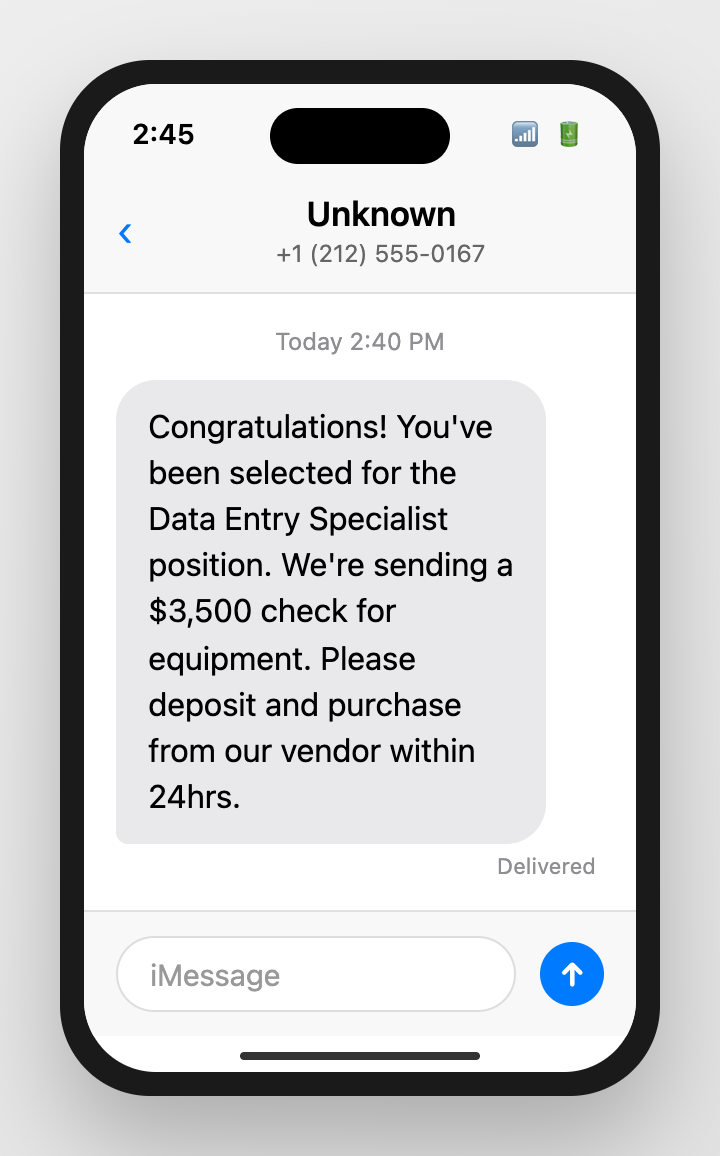
Scam 1: The Equipment Check Scam
How it works:
- You are "hired" for a remote position after minimal or no interview
- They send you a check to purchase equipment from a "vendor"
- You deposit the check and send money to the vendor (who is the scammer)
- Days later, the check bounces. You are out the money you sent.
- The "job" disappears.
Why people fall for it:
- Remote jobs legitimately require equipment
- The check deposits initially (banks make funds available before checks clear)
- The "vendor" seems like a normal business process
- You want the job to work out
Safe response: Real employers provide equipment directly or reimburse after you start. Never deposit checks from employers you have not verified, and never send money to third parties on their behalf.
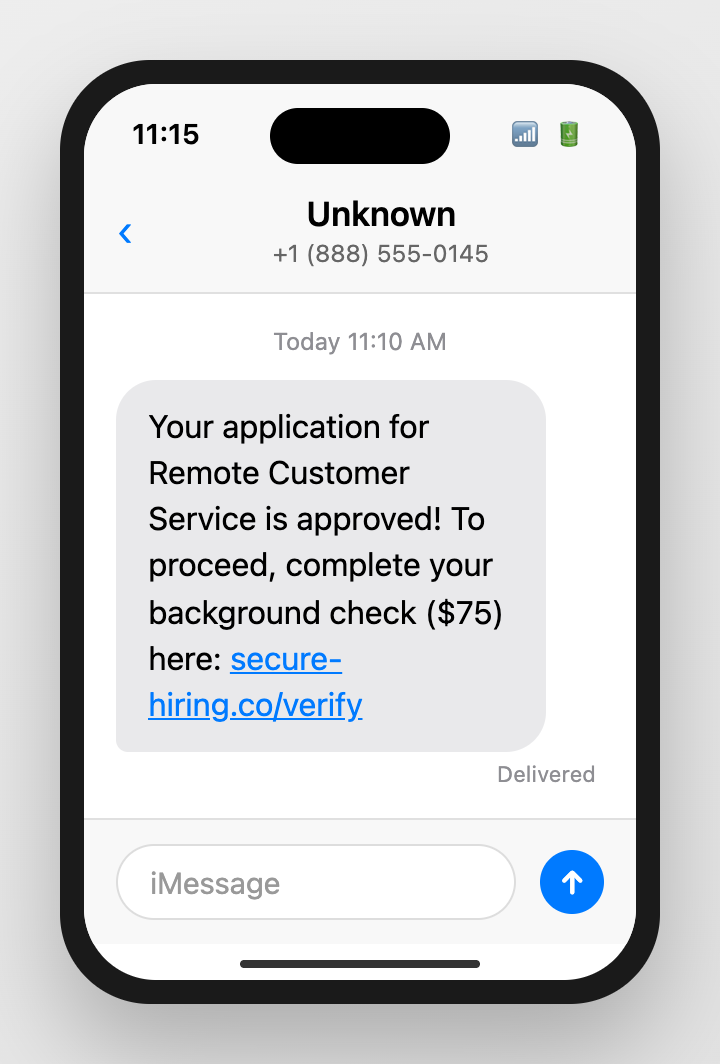
Scam 2: The Upfront Fee Scam
How it works:
- You are offered a great job opportunity via text or email
- To proceed, you need to pay for training materials, background check, or certification
- They ask for payment via gift cards, wire transfer, or cryptocurrency
- You pay. The job does not exist.
Why people fall for it:
- Some legitimate jobs do require certifications or background checks
- The amount might be relatively small ($50-$200)
- They may have created fake company websites that look legitimate
- You are invested in the opportunity
Safe response: Real employers never ask for upfront payment. Background checks are paid by the employer, not the candidate. Training is provided, not sold.
Scam 3: The Identity Harvesting Scam
How it works:
- You are contacted about a job opportunity
- They conduct a "screening" via text or chat (no video, no phone)
- They ask you to fill out an "employment application" with SSN, date of birth, bank details for direct deposit
- They now have everything needed for identity theft.
Why people fall for it:
- Real jobs do require this information eventually
- The form looks like a standard employment application
- Text-based interviews have become more common
- You want to be cooperative and professional
Safe response: SSN and bank details should only be provided after a verified job offer with a signed offer letter, usually during I-9 and direct deposit setup with HR. Never provide this information during the application or interview process.
Scam 4: The Reshipping Scam
How it works:
- You are hired as a "package handler," "shipping coordinator," or "quality control"
- Packages arrive at your home
- You are told to reship them to another address
- The packages contain goods purchased with stolen credit cards.
- You are now implicated in receiving stolen goods.
Why people fall for it:
- "Work from home" sounds appealing
- The pay seems reasonable for easy work
- The company may have a professional-looking website
- The packages seem like normal retail items
Safe response: There is no legitimate job that involves receiving and reshipping packages at your home. This is money laundering. If packages arrive that you did not order, refuse them or report to police.
Job Scam Red Flags
| Red Flag | What It Usually Means |
|---|---|
| Contacted via text from unknown number | Not a normal recruiting channel |
| "Interview" conducted entirely via text/chat | Avoiding identity verification |
| No video call or in-person meeting ever | Scammer cannot be identified |
| Job offer with no real interview | Not a real hiring process |
| Asked to pay for anything upfront | The payment IS the scam |
| Check sent to you to deposit | Fake check scam setup |
| Asked for SSN/bank before offer letter | Identity theft |
| Email from @gmail instead of @company.com | Not actually from the company |
| Job not listed on company careers page | Job does not exist |
| "Urgent" or "starts immediately" | Pressure to skip verification |
What to Do If You Have Already Shared Information
If You Shared Your Social Security Number
- Place a fraud alert with the three credit bureaus (Equifax, Experian, TransUnion)
- Consider a credit freeze to prevent new accounts from being opened
- Monitor your credit reports for accounts you did not open
- File a report at IdentityTheft.gov
- Watch for tax-related identity theft (someone filing a return in your name)
If You Deposited a Check
- Contact your bank immediately - explain the situation
- Do not spend any of the funds - they will likely be reversed
- If you already sent money to the "vendor," report it to your bank
- Document all communications with the scammer
- The bank may hold you responsible for the bounced check amount
If You Paid a Fee
- Contact your payment provider immediately
- For credit cards: dispute the charge
- For gift cards: contact the gift card company (recovery is unlikely)
- Report to FTC at ReportFraud.ftc.gov
- Report the job listing to the platform where you found it
{{component-tips}}
How Guardio Helps Protect Job Seekers
Job scammers often direct victims to fake application portals designed to harvest personal information. Guardio provides protection when you click:
- Fake application site detection: When you click a link to an "employment application," Guardio analyzes the destination. Lookalike sites impersonating real companies are blocked.
- New domain warnings: Scam job sites are often registered days before the campaign. Guardio flags suspiciously new domains.
- Email link scanning: Job scam links often arrive via email. Guardio scans these before you interact.
- Data breach monitoring: If your information does get exposed, Guardio alerts you when it appears in known breaches.
{{component-cta-custom}}
Report Job Scams
- FTC: ReportFraud.ftc.gov
- IdentityTheft.gov
- Report the listing to the job board where you found it
- Report to the real company being impersonated
Sources
FAQs
Are job offers by text always scams?
Not always, but be cautious. Verify the company and recruiter through official channels before sharing information.
What is the fake check job scam?
Scammers send a check, ask you to deposit it, then ask you to send money back. The check can later bounce, leaving you responsible.
Should I pay for equipment or training?
Be cautious. Legit employers usually have clear, official processes. Avoid paying through unusual payment methods.
What information should I never share early?
Be cautious with SSN, bank details, and one-time codes until you have verified the employer.
How do I verify a recruiter email?
Check the exact domain and verify through the company site you open yourself. Avoid relying on message links.
Where can I report job scams?
Report at ReportFraud.ftc.gov and on the platform where the message appeared.