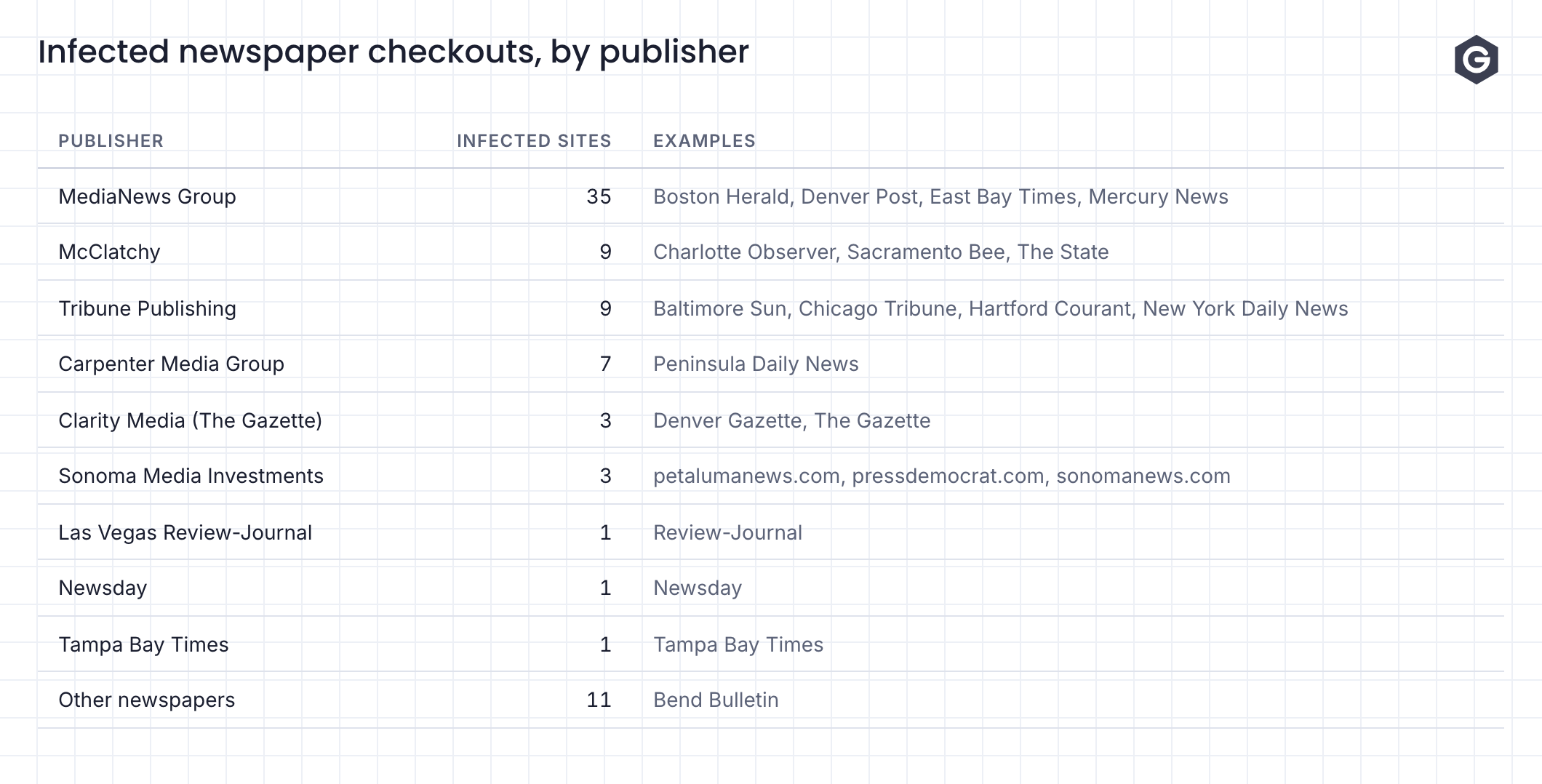
About 80 US newspaper websites, including the Boston Herald, the Denver Post and the New York Daily News, were hit through the payment form they share. From November 13, one extra line of code in that form loaded malware that stole readers’ card numbers, expiry dates and CVVs.
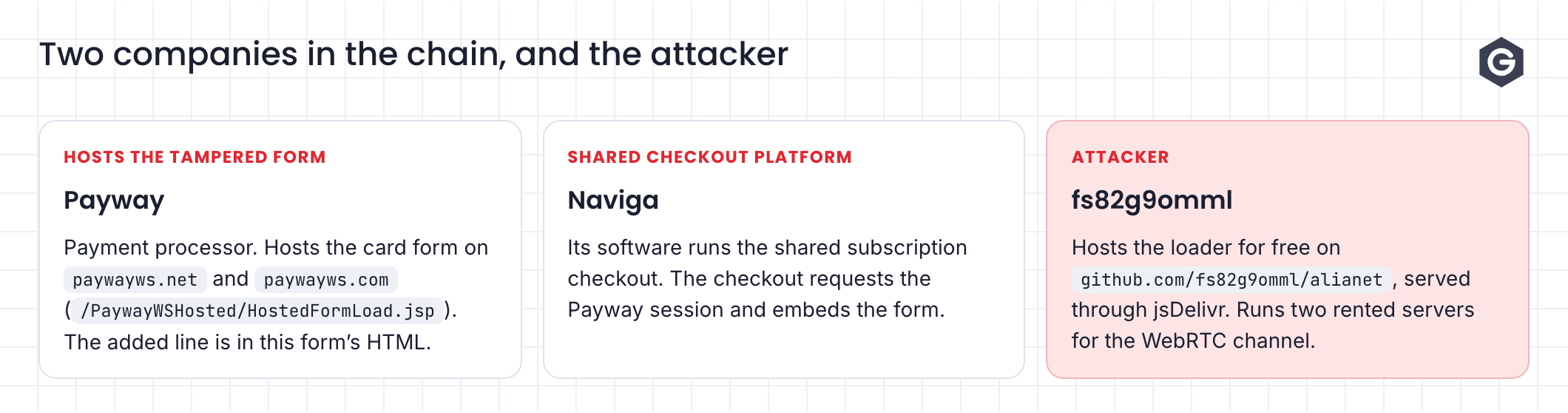
One change, dozens of papers. These papers share one checkout, built on Naviga’s subscription software. Its card form is hosted by the payment processor Payway. Someone added one line to that form, and every paper using it started serving the card stealer.
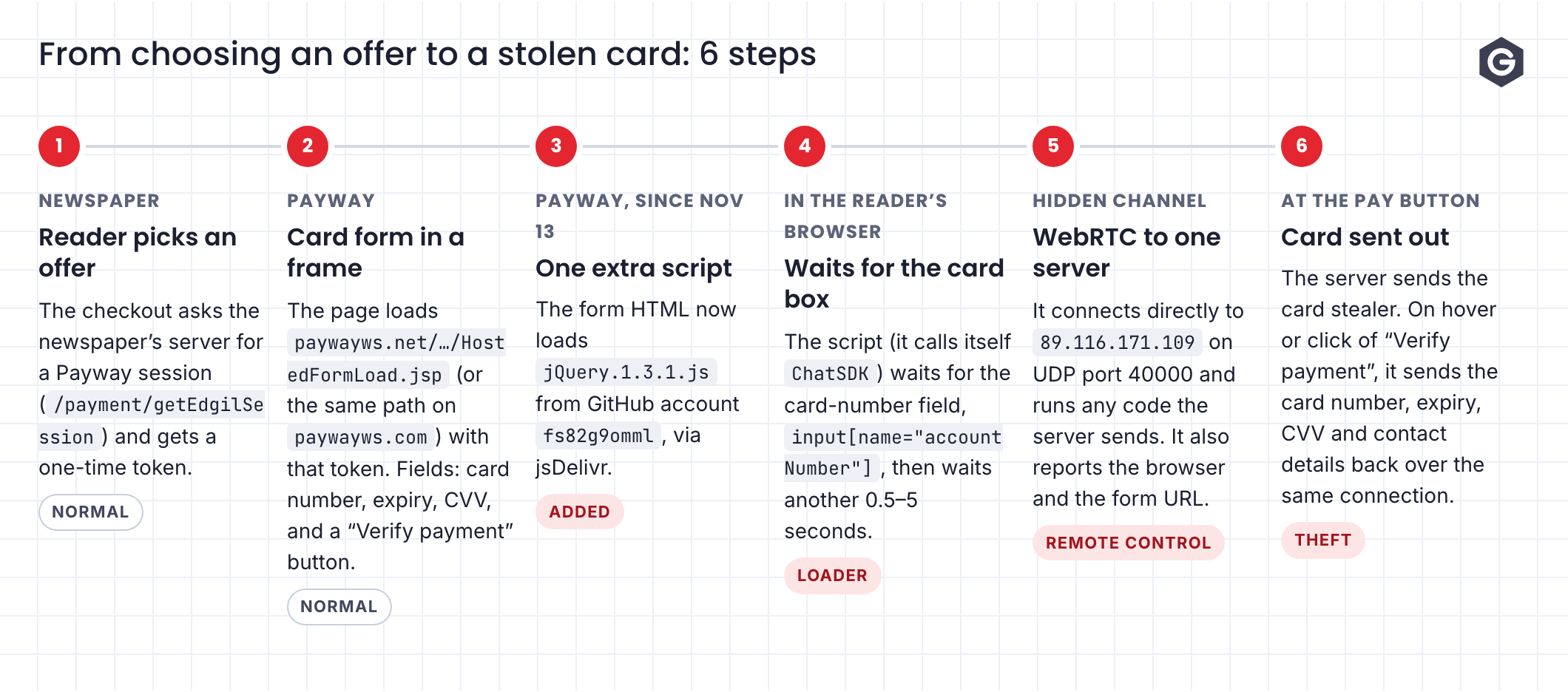
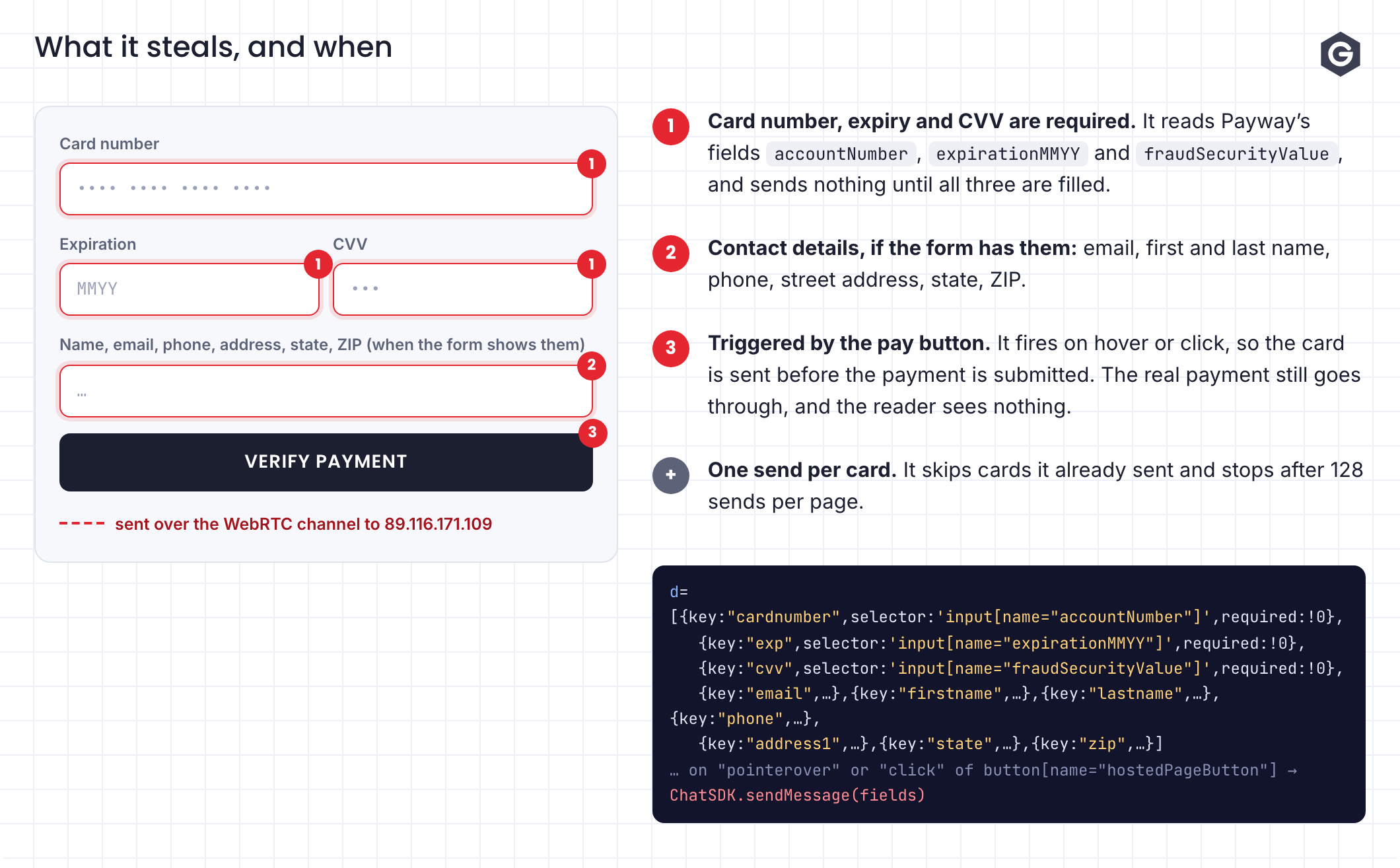
It’s hard to spot. The added line loads a file disguised as an old jQuery version. The file opens a WebRTC connection (the tech browsers use for video calls) to the attacker’s server, which sends back the card stealer. When the buyer hovers over the pay button, it sends the card number, expiry and CVV, plus name, email, phone and address if the form asks for them, over that connection. No normal web request is made, so the usual defenses miss it.
80 newspaper checkouts were infected, including the Boston Herald, the Denver Post, the Orange County Register, the Mercury News, the Sacramento Bee, the Charlotte Observer, Newsday, the New York Daily News, the Orlando Sentinel and the Sun Sentinel.
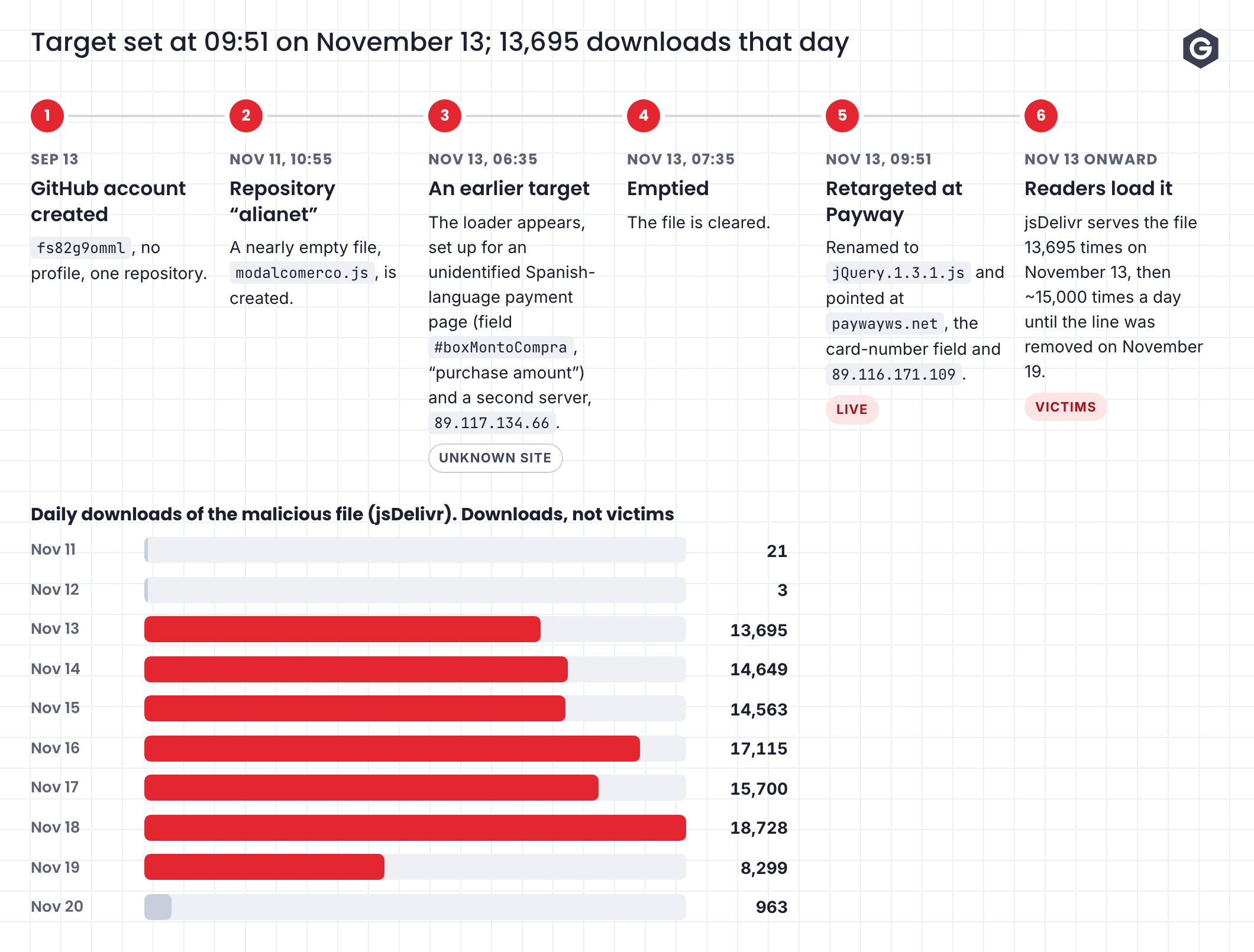
~15,000 downloads of the malicious file per day from November 13 until it was taken down (jsDelivr public stats). Each download was roughly one browser opening the card form. It is not a count of stolen cards.
Have you paid with a card on one of these newspapers since November 13? Ask your bank for a new card and watch your statements. Apple Pay, Google Pay and PayPal use their own buttons outside this form.
One line in a payment form
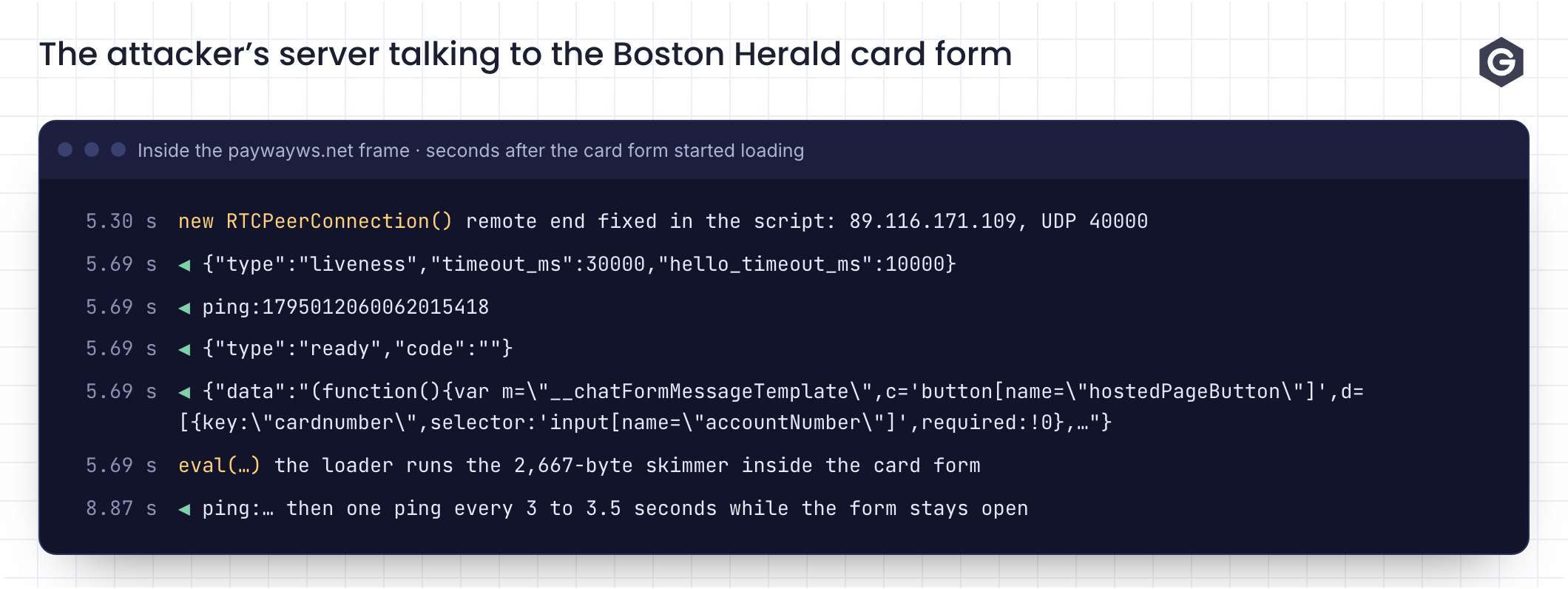
We found a card stealer (a “skimmer”) inside the card form that payment processor Payway serves from paywayws.net. About 5 seconds after the form loads, code inside it connects to 89.116.171.109. Less than half a second later, the server sends back the stealer and the form runs it (seen on the Boston Herald checkout).
The entry point is one line someone added to Payway’s card form: a script tag pointing to a file on GitHub.
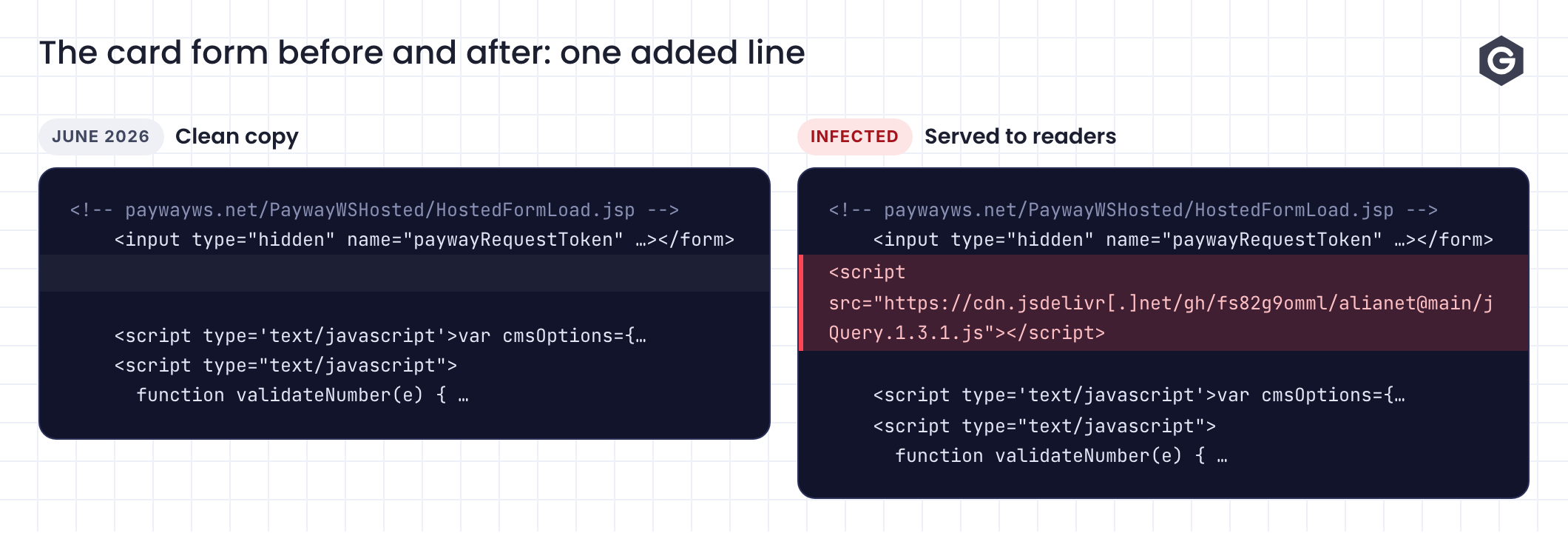
The newspaper’s own page didn’t change. The tag sits inside Payway’s frame, so the newspaper’s code, CSP and monitoring tools don’t treat it as theirs.
How the attack works
All affected papers use the same checkout platform. Their checkout domains are aliases of subscriber-concierge.com or subscriberconcierge.com, and the checkout code names its payment module after Naviga, a software vendor for newspapers. (Much of the code still uses the name MG2, a subscription vendor bought by Newscycle, which renamed itself Naviga in 2019.) For card payments, the checkout embeds a card form hosted by Payway. So one tampered form infects every paper that uses it. We named the attack PaperCut: one small cut in a form dozens of papers share, and nobody felt it.
What the server sends
The GitHub file has no card-stealing code. It’s a 12 KB remote-control loader: it opens the connection and runs whatever comes back. Anyone who downloads and reads it sees only a “chat SDK”. The actual stealer is sent over the connection, separately to each visitor.
Every infected checkout we tested got the same four messages from the server:
Why nobody noticed
We found no public report of this script, the GitHub account or the server (we checked urlscan.io, GitHub code search and the news). Here’s why it stayed hidden:
- It runs in the payment processor’s frame. The newspaper’s page doesn’t change, and teams usually trust a known processor’s payment frame the most.
- It looks like jQuery. The name
jQuery.1.3.1.jsmimics a 2009 jQuery release. It’s served from jsDelivr, a free CDN for open-source code that firewalls rarely block. urlscan.io lists thousands of pages loading files with that name. - Data leaves over WebRTC. WebRTC is what browsers use for video calls. Here it sends text from the browser straight to one server, with no HTTP request. CSP, the usual defense against skimmers, controls web requests, not WebRTC. Network monitoring tools see only an encrypted connection to an IP address, not card data. The trick isn’t new: Sansec reported the first WebRTC card skimmer in March 2026, on a car maker’s online store. What’s new is where it was planted.
- The stealer is never stored in a file. The server sends it to each visitor, so scanners that download the file find only the loader.
- It only activates on card forms. On pages without the card-number field, it does nothing.
When it started
GitHub’s commit history and jsDelivr’s stats both put the start on the morning of November 13 (all times UTC). The added line loads a file name that didn’t exist before 09:51 that day, and jsDelivr shows no downloads of it before then, so the stealer couldn’t have run earlier.
Who was attacked, and who is affected
The newspaper websites themselves weren’t modified. The modified file is Payway’s card form, served inside their checkout from both Payway domains: paywayws.net and paywayws.com (mostly smaller papers on a newer checkout version).
80 newspaper checkouts load the malicious script. The script also loads on pages where subscribers update their saved card, for example myaccount.pressdemocrat.com/pd/autopay/manage and myaccount.pressenterprise.com/pe/autopay/manage.
jsDelivr recorded 102,749 downloads of jQuery.1.3.1.js from November 13 to 19 (13,695–18,728 a day until the line was removed on November 19, then 963 on November 20). That file name only existed from 09:51 on November 13. The earlier build, under its old name, was downloaded 24 times in total, none on or after November 13.
What to do
- Ask your bank for a new card. Updating the card on your newspaper account doesn’t help: the stealer grabs whatever card you type.
- Watch your statements for small test charges in the coming weeks.
- Expect phishing. The stealer also takes your email, phone and address, so watch for fake “your subscription” or “your bank” messages.
- Paid with Apple Pay, Google Pay or PayPal? You don’t have to worry. Those payments didn’t pass through this form.
jsdelivr.net/gh/fs82g9omml, and check for WebRTC traffic to the two servers below.- Payway and Naviga: remove the line, find who edited the template on November 13, and check all other templates for the same change.
- Publishers: card-breach notification rules may apply. Identify customers who entered a card between November 13 and the fix.
- Everyone: a hosted payment form is part of your checkout. Monitor what it loads, including WebRTC connections, not just your own page.
Indicators
Appendix: affected checkout sites
Guardio Labs has shared these findings with Payway, Naviga and the publishers behind every checkout listed here. The malicious line was taken down after our report.
80 infected checkout sites.
- subscribe.auburn-reporter.com
- subscription.baltimoresun.com
- subscribe.bendbulletin.com
- checkout.bostonherald.com
- checkout.canoncitydailyrecord.com
- mycheckout.charlotteobserver.com
- subscription.chicagotribune.com
- subscribe.chinookobserver.com
- checkout.citizensvoice.com
- checkout.coloradopolitics.com
- subscription.courant.com
- subscribe.dailyastorian.com
- checkout.dailybulletin.com
- checkout.dailycamera.com
- checkout.dailylocal.com
- checkout.dailynews.com
- subscription.dailypress.com
- checkout.delcotimes.com
- checkout.denvergazette.com
- checkout.denverpost.com
- checkout.eastbaytimes.com
- subscribe.eastoregonian.com
- mycheckout.elnuevoherald.com
- subscribe.federalwaymirror.com
- mycheckout.fresnobee.com
- checkout.gazette.com
- checkout.greeleytribune.com
- mycheckout.kentucky.com
- checkout.lowellsun.com
- checkout.macombdaily.com
- checkout.marinij.com
- subscribe.marshallnewsmessenger.com
- subscription.mcall.com
- checkout.mercurynews.com
- checkout.morningjournal.com
- mycheckout.myrtlebeachonline.com
- checkout.news-herald.com
- subscribe.news-journal.com
- subscribe.newsday.com
- mycheckout.newsobserver.com
- subscription.nydailynews.com
- checkout.ocregister.com
- checkout.oneidadispatch.com
- subscription.orlandosentinel.com
- subscribe.peninsuladailynews.com
- checkout.petalumanews.com
- subscription.pilotonline.com
- checkout.pressdemocrat.com
- checkout.pressenterprise.com
- checkout.presstelegram.com
- checkout.readingeagle.com
- checkout.redbluffdailynews.com
- subscribe.redmondspokesman.com
- checkout.reporterherald.com
- checkout.reviewjournal.com
- mycheckout.sacbee.com
- subscribe.sanjuanjournal.com
- checkout.santacruzsentinel.com
- checkout.sbsun.com
- checkout.sonomanews.com
- subscribe.southwhidbeyrecord.com
- checkout.standardspeaker.com
- subscription.sun-sentinel.com
- subscribe.tacomadailyindex.com
- subscribe.tampabay.com
- subscribe.thedailyworld.com
- checkout.themorningsun.com
- mycheckout.thenewstribune.com
- checkout.theoaklandpress.com
- checkout.thereporter.com
- mycheckout.thestate.com
- checkout.times-standard.com
- checkout.timescall.com
- subscribe.tnonline.com
- checkout.trentonian.com
- checkout.troyrecord.com
- subscribe.tylerpaper.com
- subscribe.victoriaadvocate.com
- subscribe.whidbeynewstimes.com
- checkout.whittierdailynews.com
Disclosure. We disclosed these findings to all relevant parties, including Payway, Naviga and the affected publishers. The malicious line was taken down after we reported it.
Guardio Labs. Research done November 13–19, 2026, on the live checkout pages and public sources (GitHub, jsDelivr, urlscan.io). Guardio sells consumer security software. You don’t need to buy anything, from us or anyone else, to act on this article.

Were the newspapers hacked?
Their own sites weren’t modified. The infected file is Payway’s card form inside their checkout. But readers entered cards on the newspapers’ pages, so the papers will need to notify affected customers.
Is my card stolen if I subscribed before November 13?
Not by this attack. The malicious file didn’t exist before 09:51 UTC that morning.
Did you see a card being stolen?
No. We didn’t type any card, real or test, because that would send data to the attacker. We saw everything up to that point: the added line, the connection, and the stealer code the server sent. The final step is clear from that code.
Is it connected to other skimming campaigns?
The technique is similar to the WebRTC skimmer Sansec reported in March 2026 and the ones we documented on online shops in October. But we found no shared server, account or code, so we don’t claim a link.